That heavy cutlery drawer that needs a yank every time is usually not “worn out” at all. In many UK kitchens the real culprit is simple: the runners are not fully engaged in their back sockets or front clips, so the drawer is riding slightly off-line. When that happens, the metal (or plastic) runners twist, bind and feel rough, even though nothing is actually broken. Pushing the runners properly home on both sides usually restores a smooth slide in a minute or two, without new parts.
The small runner mistake that makes good drawers feel broken
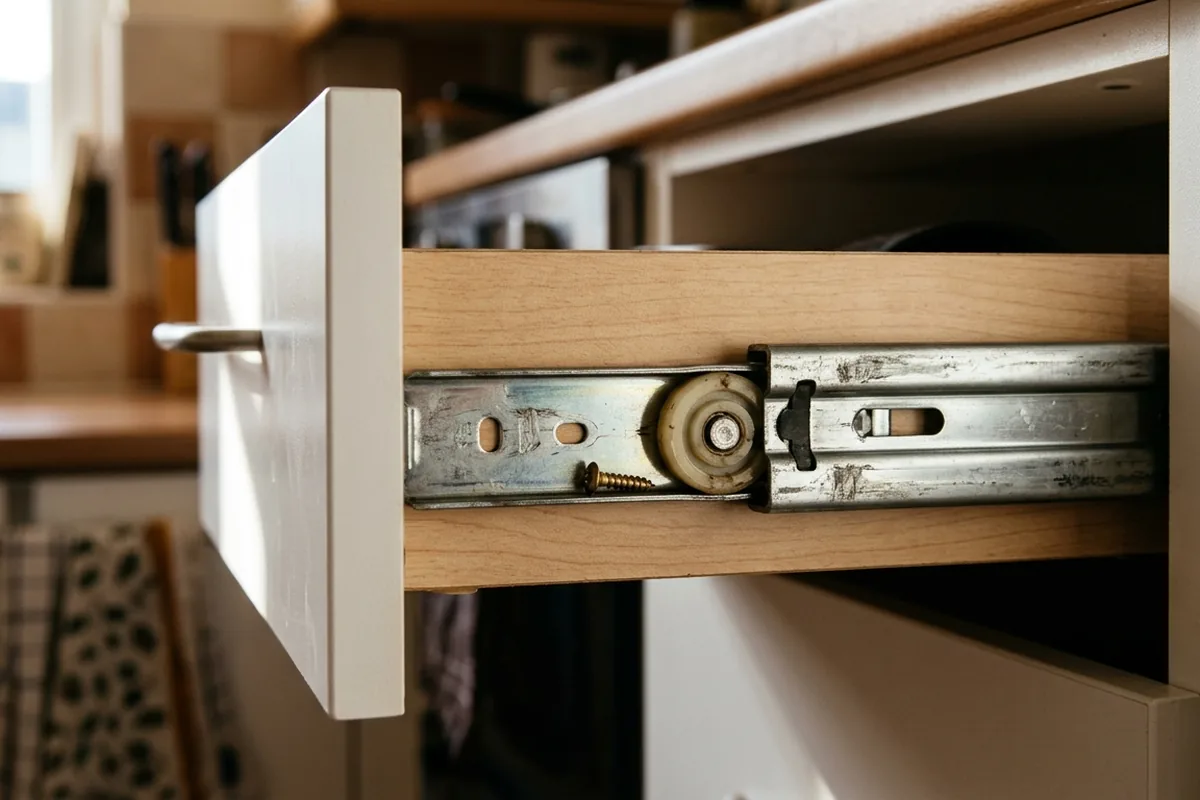
Most modern kitchen drawers sit on side-mounted runners that hook into clips at the front and plastic sockets or pins at the back of the cabinet. The common mistake is refitting the drawer so that one runner is only half seated.
That can happen after:
- taking a drawer out to clean crumbs under the hob
- overloading a pan drawer in a rented flat
- knocking a drawer sideways when it’s open
When one side is slightly out of its socket or clip:
- the drawer sits a few millimetres higher or lower on one side
- the runners no longer run parallel
- the ball bearings or plastic wheels are forced to work at an angle
The result is a drawer that:
- feels smooth for the first inch, then catches or grinds
- needs lifting on one side to close
- refuses to close the last 2–3 cm unless you slam it
If the drawer looks straight, the front is not hanging off and there’s no obvious crack in the runners, assume misalignment first, not a broken mechanism. Real damage is much less common than a runner that’s simply not clicked home.
How to re-seat a sticking kitchen drawer runner safely
You do not need to dismantle the kitchen. For most standard drawers in UK fitted kitchens from places like B&Q or Wickes, a quick removal and re-seat is enough.
First, take the weight out. A packed cutlery or pan drawer puts a lot of strain on the runners while you work and makes everything harder to line up.
1. Fully empty the drawer so you can lift it easily.
2. Pull the drawer fully open and look at each side where the runner meets the cabinet.
3. Check for:
- one side sitting higher than the other
- a gap where the runner should slot into a plastic socket at the back
- a front clip that isn’t engaged on the metal rail
Most drawers lift out in one of three simple ways. If you’re not sure, shine a torch down the side and look for a plastic lever or tab on the runner.
If your drawer lifts straight off
Many basic runners are “lift-off” types:
- Pull the drawer all the way out until it stops.
- Lift the front of the drawer slightly upwards and pull towards you.
- The drawer should come free of the runners.
Then:
- Check both runners on the cabinet are firmly fixed and level.
- Push each runner fully back so it’s sitting in its rear socket or on its pin.
- Set the drawer back on the runners, keeping it level, and slide it gently in until you feel or hear a soft click.
If there are side levers on the runners
Soft-close and higher-end runners often have small plastic or metal levers:
- Pull the drawer out until it stops.
- On each side, push up or down the lever (they usually move opposite ways).
- While holding the levers, pull the drawer straight towards you to remove it.
Then re-seat:
- Push the cabinet runners fully home at the back.
- Line the drawer up carefully so the hooks on the drawer side sit on the runners.
- Slide in slowly until both sides click.
In both styles, do not force a stiff section. If it jams halfway, pull out again and check that:
- nothing is caught behind (a fallen spoon, a screw, a bit of packaging)
- the runners are at the same height on both sides
- the rear sockets or pins haven’t cracked
Once it slides freely when empty, reload the drawer but avoid piling heavy pans at the very front. That weight encourages the runners to twist out of line again.
When sticking drawers mean another problem
If you’ve re-seated the runners and the drawer still sticks, there are a few other common, low-risk checks you can make before thinking about new hardware.
1. Swollen or damaged carcass sides
In older kitchens, especially in damp under-sink cupboards, chipboard can swell. If the cabinet sides have bowed inwards, the runners may be pinched. You might notice:
- scrape marks along the drawer sides
- a drawer that runs freely when half open but jams when nearly shut
There’s no quick permanent fix for swollen carcass boards; avoid planing or hacking away at them unless you’re confident in what you’re doing. If the carcass is visibly distorted or crumbling, it’s usually a job for a joiner or a kitchen refit, not a DIY tweak.
2. Debris in ball-bearing runners
For metal soft-close runners, grit or dried food can lodge in the ball race.
- Vacuum carefully along the runners.
- Wipe with a dry microfibre cloth.
- If they’re still rough, a tiny amount of light oil on a cloth can help, but avoid over-lubricating, which attracts dust. Silicone spray on a cloth is often safer than thick grease.
3. Overloaded or poor-quality runners
Budget runners on a wide pan drawer full of cast-iron cookware may simply be at their limit. If the drawer runs perfectly when half-loaded but struggles when full, the runners may be underspecified rather than faulty.
Upgrading runners is possible, but it can involve drilling new fixing points and adjusting fronts. If the drawer is part of a modern fitted kitchen, it’s often worth checking whether replacement like-for-like runners are available before trying to retrofit a different style.
If you’re in a rented flat and the drawer remains hard work even when empty and correctly seated, avoid forcing it. Report it to the landlord or agent so they can decide on replacement, rather than risk snapping the carcass or front.
Once a drawer glides smoothly when empty and correctly seated, most day-to-day sticking is solved. If it starts catching again within a few days, look for that same tiny misalignment: one runner just not quite clicked home.