The giveaway is usually tiny: a shelf that looks slightly “off”, a row of hooks that doesn’t quite line up, a bit of beading that stops short of the skirting board. Often the problem is not your drilling, sawing or sticking. It’s the way you used the measuring tape. The common mistake is measuring to the wrong point: ignoring the tape’s metal hook and the markings that allow for its thickness. Once you know how that end hook actually works, your small DIY jobs usually start to look properly straight and finished.
The real measuring tape mistake that ruins neat finishes
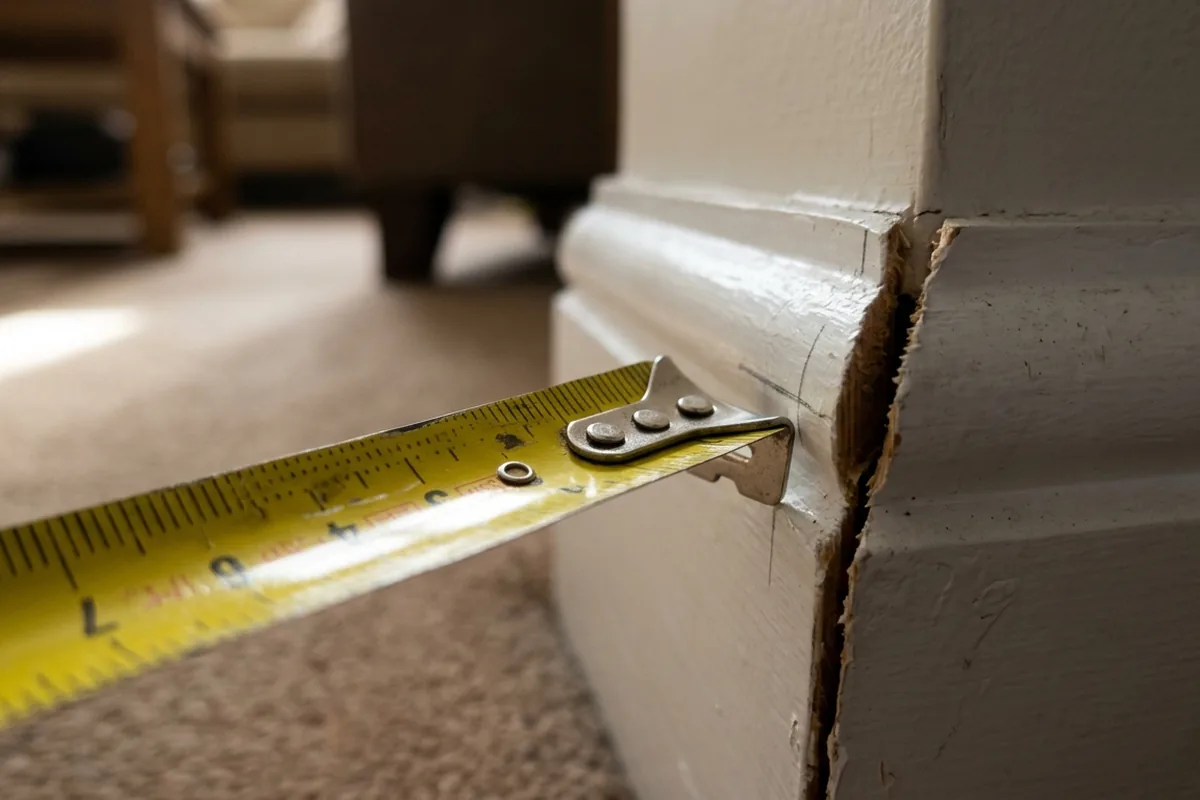
Most people treat the metal hook on the end of a tape as a simple grabber. In reality it is designed to move slightly so the tape can measure both inside and outside dimensions accurately.
The mistake that makes jobs look scruffy is this: measuring from the tape’s hook without letting it move as intended, or worse, measuring from a random point on the tape and guessing. That tiny error, often 1–2 mm each time, stacks up across a run of shelves, trims or tiles and your eye will spot it straight away.
When you hook the tape over an edge (say the outside of a door frame), the hook should pull outwards a fraction. When you push it into a corner (like the inside of an alcove), it should slide back by the same fraction. That difference equals the thickness of the hook itself.
If you:
- press the hook hard when you should let it float, or
- ignore the play and “correct” it with your finger,
you effectively add or remove the hook’s thickness from the measurement. That’s how you end up with a shelf that’s a sliver too short for an alcove, or a blind that scrapes the reveal.
How to use your tape correctly so work looks straight and intentional
Once you understand what the hook is doing, you can make a few small changes that have a big visual payoff, especially in a typical UK room where gaps show clearly against white paint and skirting boards.
1. Always measure from the same reference
For any one job, pick one method and stick to it:
- Either always hook the tape over an edge,
- or always butt the body of the tape against a surface and read from there.
Mixing methods mid-job is where misalignment creeps in, especially for things like:
- a row of picture hooks along a hallway
- fixing batons for a shelf inside a small airing cupboard
- cutting lengths of beading along a laminate floor edge
2. Let the hook “float”
When you hook onto an outside edge, pull the tape gently so the hook sits snugly but not crushed. You should see a tiny bit of movement in the rivets.
When you measure into an inside corner (for example, the exact width between two walls for a made-to-fit shelf), push the hook firmly into the corner and keep the tape body straight. The hook should slide inwards by the same amount it previously slid out.
If your hook feels completely rigid or very loose, the tape may be damaged. For anything that needs a neat finish, use a tape with a sound, slightly wobbly hook, not a bent one from the bottom of the toolbox.
3. Avoid guessing inside measurements
In a narrow alcove or under-stairs cupboard, it’s tempting to bend the tape and “read somewhere near the kink”. That almost always introduces 2–5 mm of error.
A better option:
- Measure in two parts: from one wall to a mark roughly halfway, then from the other wall to that mark, and add them.
- Or place a straight piece of timber or a level between the walls, mark it, then measure the timber flat on the floor.
This matters for things like fitting a shelf above a radiator or between two kitchen units, where even a slim visible gap looks poor.
4. Mark clearly and measure to the line, not the pencil
For small fixings on a painted wall or tiled splashback, a faint pencil mark can be thicker than the error you’re trying to avoid.
- Use a sharp pencil.
- Decide if you’re cutting or drilling to the left, right or centre of that line and be consistent.
On skirting boards, window boards and door linings, that consistency is what makes cuts meet neatly at corners instead of showing a thin sliver of gap or overlap.
Quick checks before your next “small” DIY job
Before you blame your drilling, it is worth checking the tape itself and how you’re using it. These simple checks can save a lot of re-filling, re-painting and buying a second length of timber from B&Q.
Check your tape:
- Hook movement: it should move about the thickness of the metal. Too stiff or bent, and your measurements will be off.
- Zero point: the “0” should line up with the inside edge of the hook. If it’s worn or dented, keep that tape for rough outdoor jobs only.
- Legibility: if the millimetre marks are worn, it’s very easy to be out by one or two.
Check your method:
- For anything you see at eye level (shelves, picture rails, TV brackets), work in millimetres and write measurements down.
- For repetitive cuts (like lengths of quadrant or scotia around a laminate floor), use the first accurate piece as a physical template instead of re-measuring each time.
- When drilling multiple holes in a tiled bathroom wall, measure from the same reference tile edge every time, not from the last hole you drilled.
If your small DIY jobs often end with filler, caulk or silicone sealant hiding little gaps, the next one is a good chance to slow down the measuring stage and let the tape’s hook do its job. The work will not suddenly become joiner-level perfect, but the lines will look straighter, gaps smaller and the whole thing more intentional.