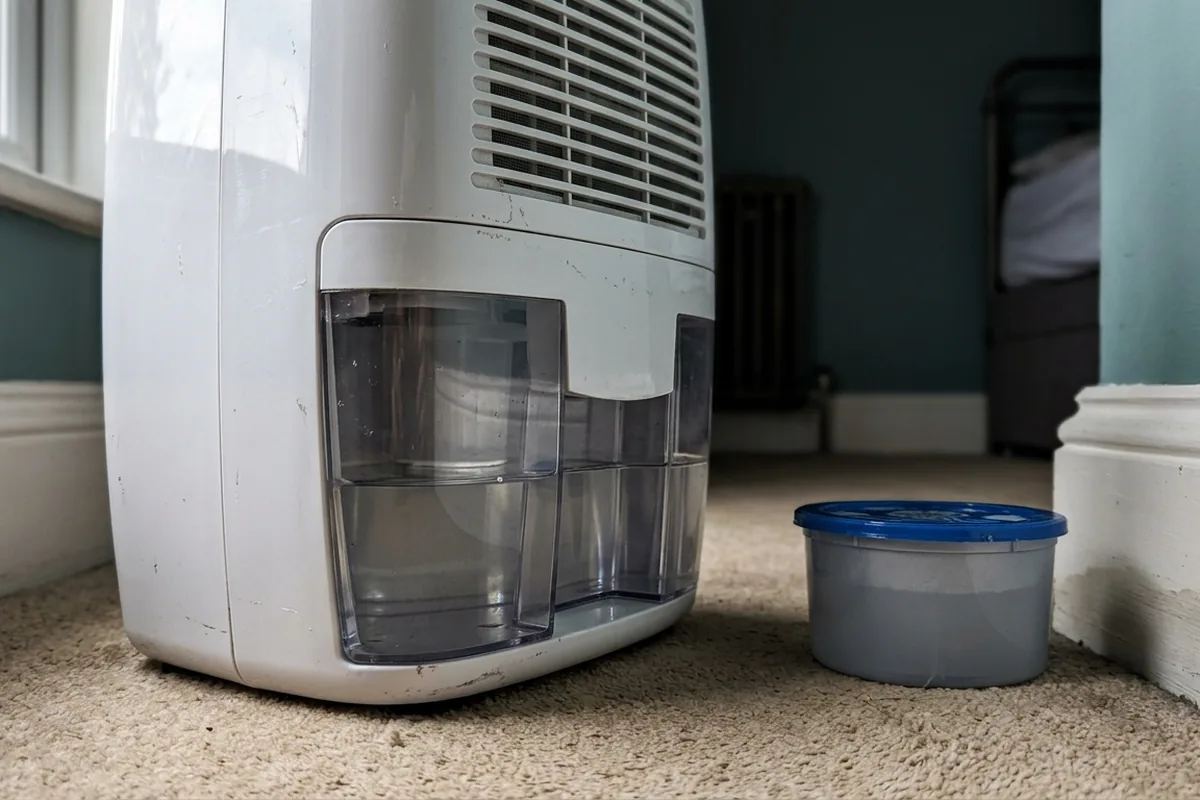
That little tub on the windowsill might look busy collecting water, but your bedroom windows are still running with condensation every morning and the skirting board feels damp. The quick answer is: moisture absorbers only help in tiny, enclosed spaces, while a dehumidifier actively dries the air in a whole room. If you are dealing with streaming windows, musty smells or mould spots on an outside wall, a cheap absorber will not keep up.
What a moisture absorber actually does – and where it runs out of road
Moisture absorbers (the tubs or hanging bags with crystals) use salts like calcium chloride to passively pull moisture from the air immediately around them. They are slow, silent and need no power, which is why they are popular in cupboards and caravans.
In a normal UK room, though, they have clear limits:
- They only affect a very small area around the tub.
- They work slowly, so they cannot cope with daily moisture from showers, cooking or drying clothes indoors.
- Once the crystals dissolve, they are finished and need replacing.
- They do nothing to warm cold surfaces, so condensation still forms on chilly window glass and outside walls.
They can be handy in:
- a closed wardrobe where coats smell a bit musty
- an under-sink cupboard that feels slightly damp
- a little airing cupboard with no ventilation
If you put one in a damp bedroom or a steamy bathroom, it is more of a gauge than a cure: if the tub fills quickly, it is telling you the moisture load is far higher than it can handle.
How a dehumidifier tackles the same moisture problem
A plug‑in dehumidifier is a different tool altogether. It has a fan that pulls room air through the machine, removes moisture and blows the drier air back out. That active circulation is the big difference.
Most decent home units will:
- process many litres of water per day, not a few hundred millilitres over weeks
- keep humidity in a controlled range, often around 50–60%
- help reduce condensation on bedroom windows and cold walls
- slow down or prevent mould on silicone sealant, window boards and skirting
There are two main types you will see in UK homes:
- Compressor (refrigerant) dehumidifiers – better for warmer rooms (typically above 15°C), like living rooms and heated bedrooms.
- Desiccant dehumidifiers – usually cope better in cooler spaces such as unheated spare rooms, lofts or garages, and they blow out slightly warm air.
If you are seeing regular condensation, musty odours or mould spots, a dehumidifier is usually the tool you need, not another pack of moisture absorbers.
Choosing between them in real rooms at home
It helps to match what you are seeing at home with what each option can realistically do.
| Situation | Moisture absorber | Dehumidifier |
|---|---|---|
| Musty smell in a closed cupboard | Often enough if the door stays shut | Overkill unless the whole room is damp |
| Condensation on bedroom windows every morning | Too weak to make a real difference | Usually effective with regular use |
| Drying clothes on an airer in a small room | Will not keep up | Very helpful, especially with door shut |
| Slight damp under the kitchen sink | Can help as a short-term aid | Not needed unless nearby walls are damp |
| Cold outside wall with mould on paint | Won’t solve the problem | Helps, but insulation and ventilation also matter |
Before you spend money, check where the moisture is coming from:
- Are you drying washing indoors without a vented dryer?
- Does the bathroom extractor fan actually work and stay on long enough?
- Are trickle vents and air bricks blocked or taped over?
- Is there any sign of a leak (staining, blown plaster, damp patch that stays wet)?
If moisture is being constantly added and has no way out, even a good dehumidifier will be fighting an uphill battle.
When a dehumidifier is not enough on its own
There are limits. A dehumidifier will not fix:
- rising damp from the ground
- a leaking pipe in the wall
- water coming through a failed roof or gutter
- badly insulated, icy-cold walls on their own
If you have persistent damp patches, crumbling plaster, or widespread black mould, especially in a rented flat, it is worth speaking to the landlord or a damp specialist rather than relying on gadgets.
Practical tips if you are currently using moisture absorbers
If your home is already dotted with little tubs, you can still use them sensibly, but do not expect them to behave like a dehumidifier.
Use absorbers for:
- small, enclosed spaces: wardrobes, under-stairs cupboards, under-sink units
- seasonal storage: boxes in the loft, a closed shed or garage cupboard
- monitoring: if a new area feels a bit damp, a fast‑filling tub hints at a moisture issue
Switch to or add a dehumidifier when:
- you are wiping bedroom windows every morning
- there is visible mould on silicone sealant, window boards or skirting boards
- clothes on an airer are still damp after a full day
- the house smells musty despite cleaning and opening windows when you can
Whatever you choose, ventilation still matters. Crack a window for a short burst, use the bathroom fan, and shut doors when you are running a dehumidifier so it can focus on one room at a time.
A cheap moisture absorber is fine as a small helper, but if your home is showing big signs of damp and condensation, it is a sign to deal with the moisture properly, not just add another tub of crystals.