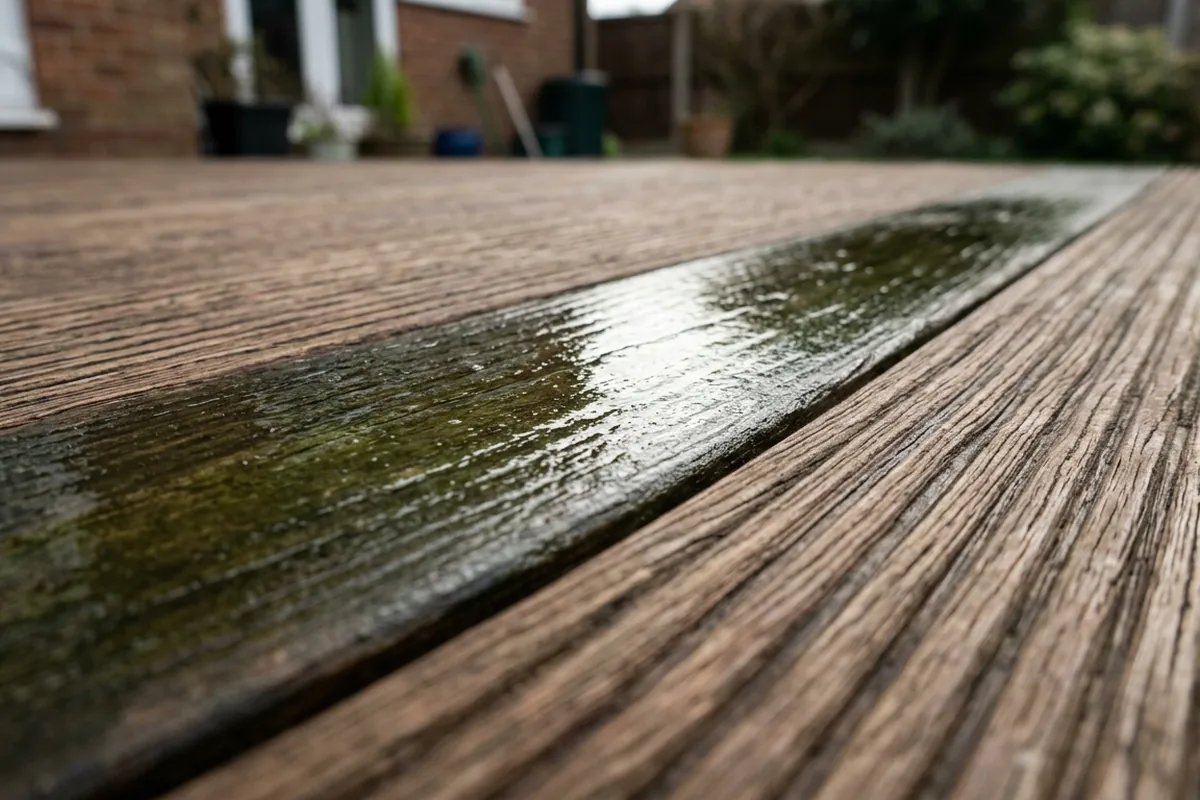
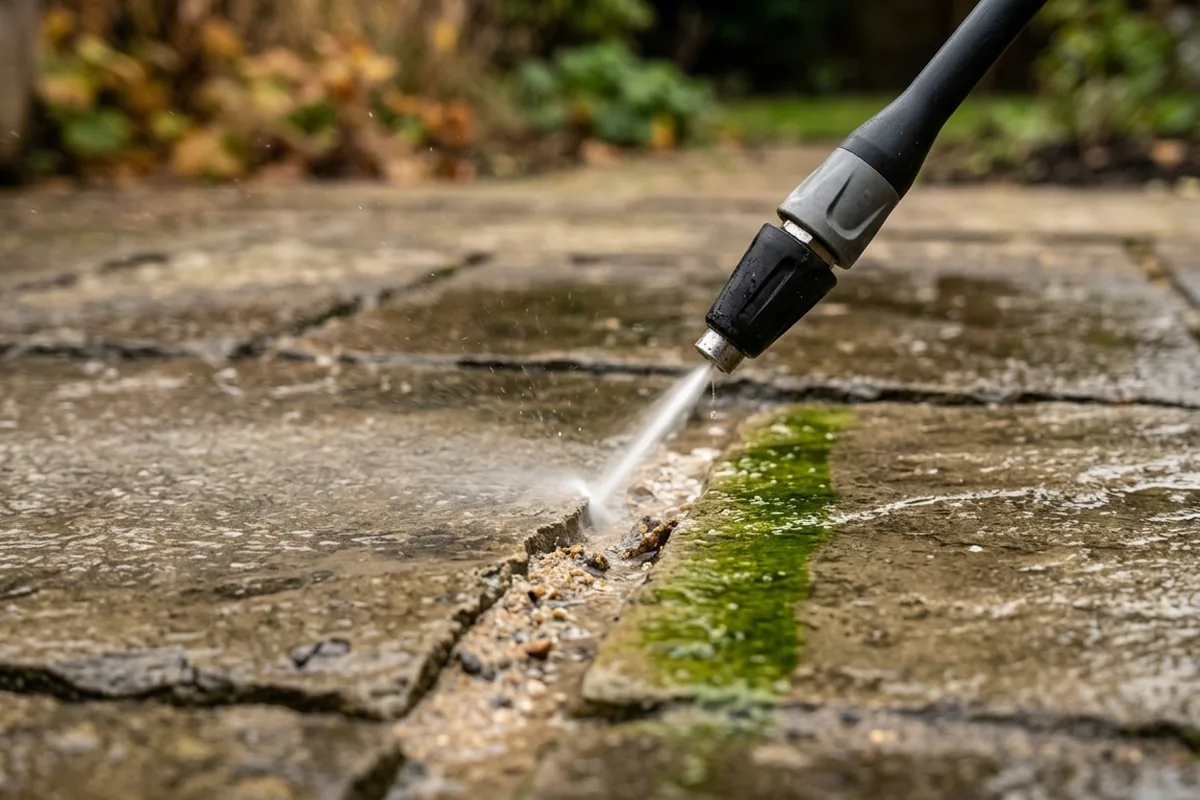
The problem often starts quietly: you blast the green slime off the patio, it looks brilliant for a week, then you spot loose sand in the joints, wobbly slabs or gaps where pointing used to be. The mistake is simple: using a pressure washer too close, at the wrong angle, and with too much power. That jet doesn’t just remove algae, it can wash the jointing material straight out, especially between block paving and patio slabs.
Used carefully, a pressure washer can clean paving without wrecking it. But if you hold the lance too near, use a narrow “pencil” jet or point it directly into the joints, you’re effectively digging them out. Once joints are open, water gets in, sand washes away and slabs can move or rock over time.
The exact pressure washer mistake that loosens joints
The key mistake is aiming a strong jet directly into the gaps between the slabs.
Most people naturally sweep the lance side to side, but if you tilt it so the jet runs along the joints, you’re doing the same job as a mini pressure chisel. This is worst when:
- You’re using the highest power setting
- You have a narrow, concentrated nozzle
- You’re working very close to the surface
On block paving drives and patios, the kiln-dried sand between blocks is what locks everything together. On many patios, a weak mortar or brush-in jointing compound is all that’s holding the edges firm. A harsh jet can strip this out in minutes, leaving you with:
- Gritty sand sprayed over the slabs
- Dark, open gaps between blocks or flags
- A slightly hollow or rocking feel when you walk over certain areas
Once that happens, water and winter frost can make movement worse.
The safer approach is to treat the joints as fragile, not as dirt traps. Clean the surface, not the gaps.
How to clean paving without blowing the joints out
You don’t have to give up on your pressure washer. You just need to treat it more like a paint sprayer than a demolition tool.
Aim for: lower pressure, wider fan, and a shallow angle to the slabs.
A simple way to think about it:
| Surface or paving | Safer washer approach | Avoid |
|---|---|---|
| Block paving drive | Medium power, wide fan, keep lance 20–30 cm away | Pencil jet, close range, spraying along joints |
| Slab patio with sand joints | Lower power, quick passes across slabs | Holding jet on one spot, blasting out loose sand |
| Patio with brush-in compound | Gentle rinse after chemical/algae cleaner | Direct jet at joints, repeated passes over same line |
| Old or cracked mortar joints | Soft-brush scrub and hose, or very gentle fan | Any high-pressure cleaning close to joints |
A few practical checks while you work:
- Keep the lance moving: never park the jet in one place.
- Work across the slabs, not along the joints. Think “sweeping the surface”, not tracing the lines.
- Check the sand or joints every few minutes: if you see fresh gaps, ease off immediately.
- Use a patio cleaner attachment (the round “hood” type) if you have one; these spread the pressure more evenly and are kinder to joints.
If your paving is older, with obvious cracks in the pointing, consider scrubbing with patio cleaner and a stiff brush and rinsing with a garden hose instead. It’s slower, but far less destructive than a powerful jet on weak mortar.
What to do if your joints are already loose
If your last enthusiastic clean has already damaged the joints, it’s usually fixable, but don’t keep pressure washing until you’ve sorted the problem.
If you have block paving
For a typical block-paved drive or path outside a terraced house:
1. Sweep the surface thoroughly when dry.
2. Brush kiln-dried sand into the joints, working it in from different directions.
3. Sweep off the excess and let traffic and rain help settle it.
If blocks are badly sunken or rocking, that’s beyond a quick top-up. In that case, it’s better to get a paving contractor to lift, re-level and re-lay the area rather than keep washing sand out and hoping it settles.
If you have slab paving with mortar or jointing compound
Where you’ve blown out chunks of pointing between slabs on a garden patio:
- For small patches, you can rake out the loose bits and repoint those joints with an outdoor mortar mix or a suitable jointing compound, following the instructions.
- Work on a dry day and avoid walking on the joints until they’ve cured.
If a whole area has lost its joints and slabs feel loose, repeated DIY patching won’t last. That’s the point to pause on heavy cleaning and think about a more thorough re-lay or professional repair.
Once you’ve repaired the joints, treat your pressure washer as a finishing tool: lower power, wider fan, and use it sparingly. For regular maintenance, a stiff broom, a bit of patio cleaner and a hose are usually enough to stop algae building up without attacking the structure of the paving.
If your paving still looks solid, the simplest test next time is this: after cleaning, check the joints rather than the shine. If the gaps look the same as before you started, you’ve got the balance about right.