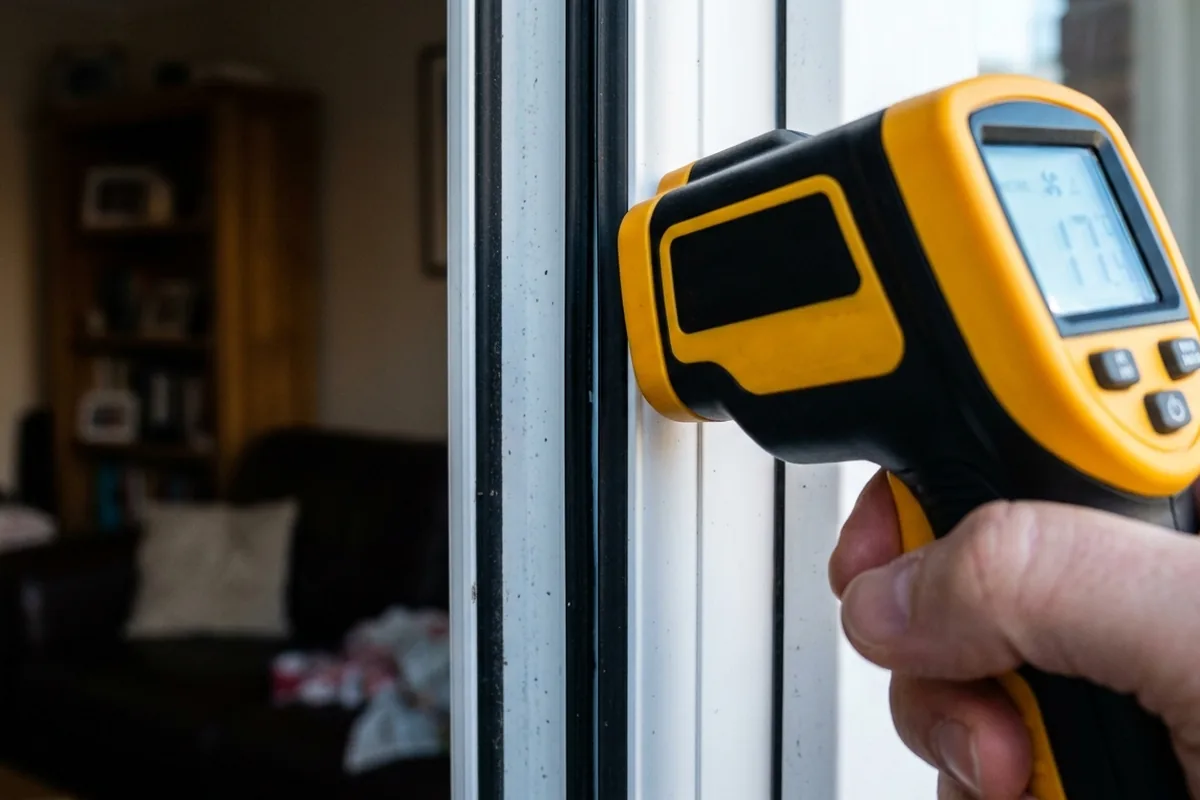
That faint cold patch by the living room window, the whistling by a draughty door, or a fridge that feels warmer than it should: small leaks are easy to feel but hard to see. The simplest tool for tracking them down is a cheap handheld infrared thermometer – the point-and-click kind with a little laser dot. It shows surface temperature, so you can quickly spot where cold air is sneaking in around window frames, letterboxes, loft hatches and fridge or freezer seals.
Used properly, it can highlight tiny gaps and failing seals in minutes, but it will not fix the problem on its own. It is an indicator, not a repair. Before you start sealing anything, you still need to check ventilation, avoid blocking trickle vents and be realistic: serious damp, rotting frames or major heat-loss issues need professional assessment.
How an infrared thermometer helps you find small draughts and seal failures
An infrared thermometer measures the temperature of surfaces, not the air. When you scan around a window, door or seal, sudden cold spots usually point to a gap or a flattened or cracked seal.
On a chilly day, work slowly around:
- window frames and sills in bedrooms and lounges
- the edges of a draughty front door and letterbox
- sliding patio doors and French doors
- fridge and freezer door seals
- loft hatches and attic doors
You are looking for areas that are noticeably colder than the surrounding surface, for example a strip along the hinge side of a UPVC window or a short section of fridge seal where the temperature drops sharply.
For best results:
- Use it when there is a decent temperature difference between indoors and outdoors (cool evening or winter morning is ideal).
- Hold it roughly the same distance from the surface as you move along, so your readings are comparable.
- Move slowly. If the numbers suddenly dip, pause and rescan that area.
The tool is especially handy in a typical UK terraced house or rented flat where you can feel a draught near the skirting board or window board but cannot see an obvious gap.
Where this tool is brilliant – and where it is not
Infrared thermometers shine when you need quick comparisons, not precise engineering figures. They are brilliant for hunting relative cold spots around:
- old silicone sealant on UPVC windows
- rubber door seals on washing machines and fridges
- the frame-to-wall join around replacement windows
- loft hatches above a landing or in an airing cupboard
- cat flaps and letterboxes in windy weather
They are less useful when:
- the whole wall is cold because the room is unheated
- the sun is on one side of the house, warming surfaces unevenly
- you are trying to diagnose serious damp inside a wall rather than surface draughts
A quick way to think about it:
| Situation | Tool is very useful | Limit or caution |
|---|---|---|
| Cold line along window edge | Good sign of draught or weak seal | Still check trickle vents and ventilation needs |
| Patchy cold spots on door frame | Helps target new draught strip or sealant | Won’t show hidden rot or structural issues |
| Fridge feels warm at front | Can reveal a short section of failed door seal | Won’t diagnose compressor or gas problems |
| Whole outside wall feels cold | Less helpful as everything reads low | May be insulation or damp, not a simple gap |
If your readings show large areas of very cold wall, flaking paint or damp skirting boards, that is more likely a damp or insulation problem than a simple draught. That goes beyond what a cheap thermometer and a tube of sealant should tackle.
What to do once you have found a cold spot
Once the thermometer has shown you where the cold strip is, you can do a simple visual and touch check.
For a window or door:
- Run your hand slowly along the area with the heating on. If you can feel a definite draught, the seal or draught strip is likely past its best.
- Inspect the silicone sealant for cracks, gaps or places where it has pulled away from the frame.
- Check that trickle vents are open and working; do not block these with sealant or tape, as they are there for safe ventilation and to reduce condensation and mould.
For a fridge or freezer:
- Look for flattened, split or mouldy rubber seals where the cold spot showed up.
- Close the door on a strip of paper at that point. If you can pull the paper out easily, the seal is not gripping properly.
The thermometer has done its job once it has narrowed you down to a short section to repair or replace. At that stage you are into normal home fixes: fresh silicone around a window, new self-adhesive draught strip on a door, or a replacement fridge seal if the appliance is otherwise in good condition.
If you start finding widespread cold readings, black mould around window seals or persistent condensation on bedroom windows even after basic draught sealing, treat that as a sign to pause and get proper advice rather than adding more sealant. The tool is there to guide your eye and hand, not to replace a surveyor or heating engineer.