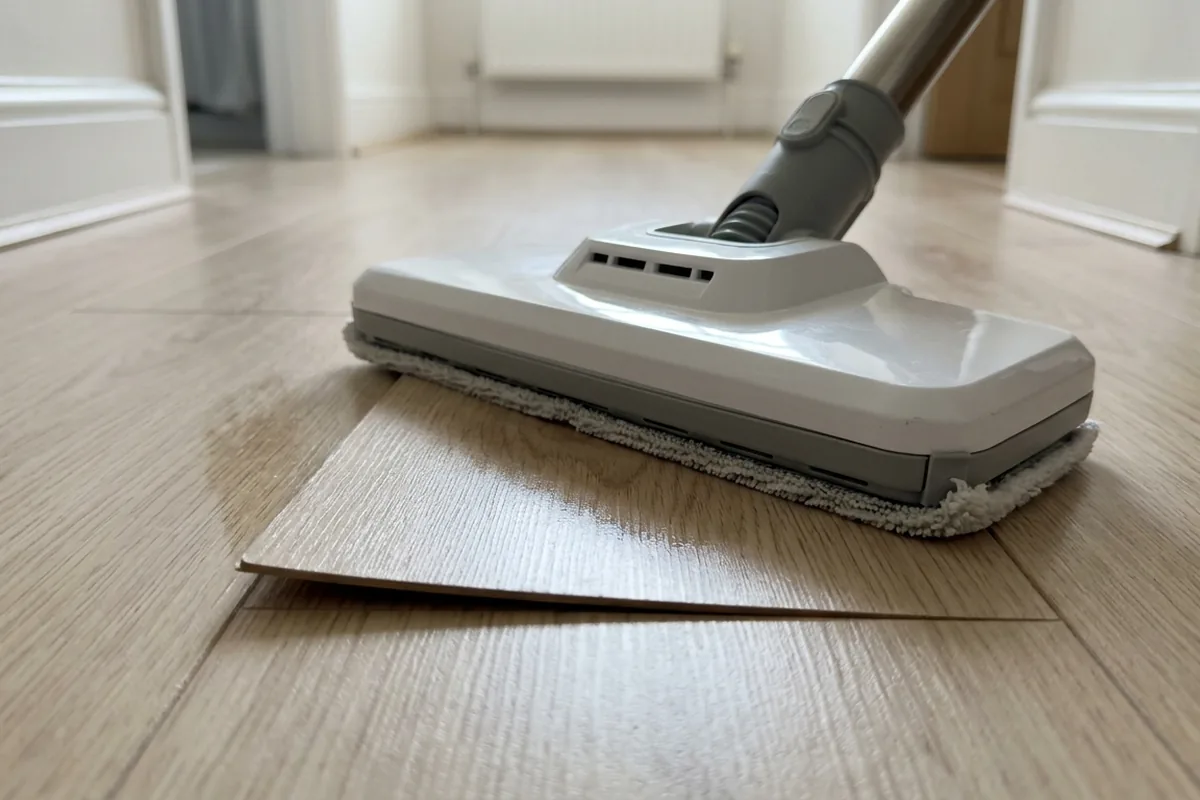
The issue usually starts when you glide a steam mop over the laminate in the lounge or the engineered wood in a rented flat, and a few days later the boards are curling, gaps appear or a dull patch won’t go away. Steam feels like a “safe” way to clean because it is just water, but the heat and moisture can quietly wreck certain floors. The short answer: steam cleaners are fine only on a small number of hard, well-sealed surfaces, and even then with care. They are not safe on most laminate, engineered wood, solid timber, vinyl and some tiles, because steam forces hot moisture into joints, glue and finishes that were never designed for it.
Where steam cleaners are risky and why
The danger with steam is penetration, not just dampness. You are pushing very hot vapour under pressure into every gap, joint and scratch. On the wrong floor that means swelling, warping, lifting and discolouration.
Here is how that plays out on common UK floors:
- Laminate flooring: The “wood” you see is a decorative layer on top of compressed board. Steam can drive moisture through the joints, causing the core to swell. You end up with raised edges, soft spots and blown joints, especially near the kitchen sink or back door where water already collects.
- Engineered wood: Better than laminate, but still layered. Excess heat and moisture can soften adhesives and make boards cup or the top veneer lift. Once the top layer bubbles, it cannot be fixed with cleaning.
- Solid wood boards: Wood moves with moisture. Steam can cause cupping, gaps and finish damage, particularly on older floors in terraced houses where there is already some draught and movement.
- Vinyl and luxury vinyl tile (LVT): Many manufacturers explicitly say no to steam. Heat can soften glue, lift edges and mark the surface. On click-together LVT, steam can still get into the joints and underlay.
- Ceramic and porcelain tiles: The tile itself usually tolerates steam, but the grout and any loose or hollow tiles may not. Repeated steaming can weaken crumbly grout or push moisture into a poorly sealed subfloor.
- Natural stone (slate, limestone, marble): Sensitive to heat shock and to water driven into pores and tiny cracks. Steam can strip sealers and encourage staining. If the stone is not perfectly sealed, avoid.
The pattern is simple: if the floor relies on a finish, glue or board core staying dry and stable, steam is a risk.
How to check if your floor can cope with steam
Before you roll a steam mop across the whole kitchen, pause and do three checks: the paperwork, the construction and the condition.
1. Check the manufacturer’s instructions
If you still have a box, booklet or can find the product online, look for cleaning guidance. Many brands say clearly:
- “Do not use steam mops”
- “Damp mop only”
- “Use pH-neutral cleaner and well-wrung cloth”
If steam is not clearly allowed, assume it is not safe. Warranty terms are often voided by steam damage.
2. Work out what the floor actually is
In a lot of UK homes and rented flats, people are not quite sure what they are standing on. A quick look at offcuts in the cupboard, under a threshold strip or at a radiator pipe cut-out can help you tell laminate from solid wood or vinyl. If you are unsure and it looks like wood or wood-effect, treat it as vulnerable.
3. Inspect the condition
Even a surface that can usually handle steam becomes risky if it is already compromised:
- Gaps, lifted edges or chipped boards
- Cracked tiles or missing grout
- Soft patches near the washing machine or dishwasher
Steam will drive moisture into those weaknesses and make them worse.
If you pass all three checks and still want to try steam, test a small, hidden patch, use the lowest setting and a thick microfibre pad, and keep the head moving. Any lifting, dullness or roughness afterwards is a sign to stop.
Safer ways to clean delicate floors (and when steam is useful)
For most everyday cleaning, you do not need steam at all. A slightly damp microfibre mop and a mild, pH-neutral floor cleaner are usually enough, especially on modern finishes.
For laminate, engineered wood, solid wood and LVT:
- Vacuum or sweep with a soft brush to remove grit.
- Use a flat mop just damp, not wet. If you can see standing water, it is too much.
- Wipe up spills around the fridge, dishwasher and patio doors straight away.
- Avoid vinegar on wood and laminate: acidity can dull finishes and damage some sealers.
Where steam can be helpful, with care:
- Well-laid ceramic or porcelain tiles in the kitchen or hallway, with sound grout and a stable subfloor.
- Some sealed vinyls where the manufacturer specifically allows steam at low settings.
- Tiled bathroom floors with good silicone sealant at edges and a working extractor fan, so moisture clears quickly.
Even here, use steam sparingly, not as your only method every day. Think of it as an occasional deep clean, not a routine.
If you are dealing with mouldy grout, limescale on tiles or a musty bathroom floor, a targeted bathroom cleaner or limescale remover, used with gloves and good ventilation, is often more effective than blasting steam around and driving moisture into corners.
When you are tempted to “just run the steam mop over it”, especially in a rented property, ask one question: if these boards lifted tomorrow, could I afford to replace them? If the answer is no, stick to low-moisture cleaning and surface-safe products instead.